jueves, 24 de febrero de 2011

Chao Chile


So after getting back to Chile I had a very sad realization to make. I had just a few days left in the country I had come to love so much. It wasn't going to be easy leaving the friends I'd made, with their great hospitality and sense of humor. But I was torn because at the same time, I was excited to get home to MN and ND and see all these friends I had missed. The biggest thing I'll miss from Chile is definitely my family. Even though I left to travel a lot of weekends, a whole semester is a long time to spend with a family and you get to know them really well. I'll miss playing ping-pong with my uncle Ricardo and sister Cami. Even though it's hard to admit, I'll miss Vale constantly criticizing and correcting my Spanish. I'll miss getting beat by my brothers time after time on the Wii but maybe showing them a little about playing soccer. I know I'm going to miss my dad Leo's amazing asados, or barbecues, every Sunday. I'll also miss talking all things soccer and especially Colo-Colo with my cousin Max and all my conversations predominantly about food with my mom Leticia. Last but not least, I'll miss the fun and always cheerful, even if somewhat random, conversations with Abueli, or my grandma. I know I'll go back to see them someday.

Lastly, a shameless plug for Chile. You should all visit. And what will you do with your time there? Well let me provide a few suggestions. First of all, you need to visit Valparaíso. It's so close to Santiago (which you will undoubtedly also visit) and such a unique city that it definitely merits a visit. After this, the best parts of Chile are at the extremes. The Atacama desert in the North is sensational, and the best place to explore the area is San Pedro de Atacama. After this, travel down the the Southern tip of the continent to Patagonia. The highlights here are Torres del Paine, La Carretera Austral, and Parque Pumalín, but you really can't go wrong visiting anything down here. I have no regrets from the semester except that I wish I had had more time.

New Years on the water and Buenos Aires


The adventure continued as we left Patagonia. We spent one night in an incredibly uncomfortable car ferry where the crew thought it would be a good idea to play old John Travolta movies on full volume for the whole night. I mean, Saturday Night Fever really isn't that good. So after a very poor night of sleep, we headed out to the great national park Vicente Peréz Rosales. We saw more incredible volcanoes, the magnificent Petrohué waterfalls, and some more of the beautiful Chilean South. After a day in the park, exhausted, we climbed onto another overnight bus, meaning that for 2 straight nights now, we had not slept on anything resembling a bed. I'm real nice to my parents, aren't I? Immediately after getting into Santiago, we left our luggage at the bus stop baggage check and tried to find a bus out to Valparaíso. Buses are run by tons of companies and leave about every 10 minutes, but because this was New Years Eve, and Valparaíso is such a popular destination for this holiday (more to follow on this), buses were 100% sold out! So we bit the bullet, hired a private car, and made the trip out amongst what seemed like the rest of Santiago.

I soon had the opportunity to introduce my two families, as we were meeting my Chilean family in Valparaíso. Although I had introduced them over SKYPE, it was fun to introduce them in person. We had a great lunch and made our way down to the harbor for what was to be an amazing night. First of all, it's important to understand what Valparaíso means on New Years. Every single Chilean told me that I needed to do whatever possible to get to "Valpo" on New Years. Year after year, the spectacle is incredible, and as the bicentennial, this year promised to top the rest. So both families and other Chilean friends boarded a small boat and set off into bay. From here we had a perfect vantage point for the coordinated fireworks that ran up and down the coast for probably 25 miles. It was far and away the best fireworks show I have ever seen and left everyone in awe, made all the better by the fact that we were looking into the lit hills of Valpo behind the fireworks. Certainly something I will never forget. After the show, we had to get back to Santiago. Due to the popularity of New Years in Valpo, hotels and hostels literally up their prices by multiples of 5 to 10, so staying in Valpo was not really a feasible option. Instead, we were lucky enough to have my great Chilean host dad Leo champ up and drive the 2 hours back home. Despite our best efforts, we all fell asleep in the car, leaving Leo to carry the team.

Having my two families meet was absolutely fantastic. After a semester of trying to tell each family what my other family was like, it was great to get them together and see how shocked my sisters were that I looked so much like my brother and dad.

After a short stay in Santiago, we headed off to Buenos Aires, a must see destination in South America (I feel like I'm saying that about everywhere...). We rented an apartment in the really cool neighborhood of Recoleta and spent 5 days visiting as much as we could of this awesome city. It's very different from Santiago and was built when Argentina was the more prosperous country of the two (as opposed to Chile is today). This means that there are grand buildings mimicking the best of Europe all over the city. It's really a great city to walk around in and just kind of get lost. We spent time in the old port area of La Boca, which is also home to the much loved Boca Juniors soccer club. We toured the stadium and got a taste for how much Argentinians really do love their fútbol. We also spent some time in the cobblestone lined neighborhood of San Telmo, one of my favorites of BA, the large beautiful parks of Palermo, and the hectic downtown area of El Centro. Before South America, I'd never really realized the interest in visiting cemeteries, but the Recoleta Cemetery was a really cool attraction. But one of the highlights had to be the steak. Argentina is famous for its beef, and the acclaim is well deserved! One night my parents spoiled my brother and I by bringing us to one of the best steakhouses in BA, Cabaña Las Lilas. It was absolutely sensational, twice as good as any steak I've ever had in my life, easily. So tender and juicy, cooked perfectly. And to match every customers taste, the restaurant has an impressive 100 page wine menu! Somewhat overwhelming to say the least. But our time in BA came to an end and we boarded our plane back to Santiago.

lunes, 21 de febrero de 2011

La Carretera Austral


From Puerto Montt (near Puerto Varas), my family and I rented an awesome pickup truck, outfitted it with a flashy tarp to waterproof the bed, and boarded an overnight ferry to Chaitén, a major starting place for the famous Carretera Austral, or Southern Highway. Chaitén itself was largely destroyed by the 2008 eruption of nearby Volcán Chaitén. Today it's an eerie sight, still littered with abandoned and destroyed homes and covered in volcanic ash. It's very much a ghost town and reminds me of the descriptions in Cormac McCarthy's book "The Road" if anyone has read that (or seen the movie). A little background on La Carretera. The farther South you get in Chile, the harder it becomes to navigate. The country starts to become a multitude of islands instead of a continental mainland, and the mountains make the terrain very rough. But during the 1970s and 1980s, the Chilean government decided to connect the small isolated towns with a major highway. But lets be honest, the "highway" is just a glorified dirt road through the most beautiful landscape I have ever seen.

The road meanders through mountains, over rivers, past waterfalls and glaciers and through ancient forests. It's a very windy road, full of pot-holes, and rarely wide enough for two cars to pass comfortably. The combination of the dangerous road and beautiful scenery force you to drive slowly both for safety and for an opportunity to draw all the sites in. Although I had anticipated slow moving on the road, I had been overly optimistic and we soon realized that for the next 5 days we were going to be driving about 10 hours a day, a pretty major undertaking. Our first day of driving brought us down to Coyhaique, the largest city within hundreds of miles with a whopping population of about 45,000. As the major draw for us was not the cities/towns, we didn't spend much time in Coyhaique but instead continued down to Chile Chico the next day. Set on the southern end of Lago General Carrera, the biggest lake in Chile, it sits just a couple miles from the Argentinian border. The drive into town is easily the most incredibly driving I've ever done. With a steep cliff up to your right and an equally steep cliff down into the lake on your left, the windy and narrow road requires every bit of concentration you have as a driver. We spent a day of rest here, visiting a nearby national park with ancient hand paintings before heading back north. This is also where we spent Christmas. Let me tell you, it's strange to celebrate Christmas without snow, but even stranger for it to be the summer. Something just didn't feel right. Especially since most of the decorations are based off of Christmas in the Northern Hemisphere, so Santa is dressed in a winter jacket and is surrounded by snow. Whatever...

Thanks to the kindness of a Chilean man we met at our hostel, we were able to take his spot on a car ferry and save several hours of driving and see a slightly different part of the landscape. We continued north past Coyhaique to Puerto Chacabuco, a major drop off for cruises in the area and spent the night in 4-star luxury at the only real destination in the port town. The town wasn't much to see, but it fell on a good spot on our route and let us sleep well for a night and gave us the first internet access in several days (something very important when I realized the ferry company was about to cancel our return trip from Chaitén to Puerto Montt!). After sorting that mess out, we set off the next morning to a highlight of the trip, Parque Pumalín, a monstrous private park founded and owned by Doug Tompkins, the founder of North Face. He bought the land to protect it from further development and has created an absolutely amazing place. Despite suffering damage from the same eruption of Volcán Chaitén, the park was just recently reopened when we visited and was absolutely amazing. From ancient and gigantic alerce trees (Chile's version of the redwoods) to dolphins and beautiful waterfalls, it's an incredible area where we all wish we could have spent more time.

Pickin up the Fam


After a nice overnight bus ride to Santiago, I got to pick up my family at the airport. We were both pretty exhausted from the previous night's travels, but I decided it was still a good idea to run the ragged around Santiago. We hit a lot of the big hotspots in Santiago like Cerro Santa Lucia, La Moneda Palace, and my favorite ice cream place, Emporio La Rosa. It was great to see them and be able to show them around my home for the past 5 months. That night, in order to not let them get too comfortable in their new surroundings, we took an overnight bus right back to Pucón (wasn't I just there not 24 hours earlier?). I wanted to make the most of their time here and knew we'd have time in Santiago later in the trip. The only difference about this bus trip was that we opted for the luxurious cama, or bed seats, with comfy seats that fold almost flat. It's nice to travel on something more than a shoe-string budget!

In Pucón, I had saved the best tour to do with my family, the all day ascent of Volcán Villarica. At over 9000 ft, and as one of Chile's most active volcanoes, it is truly a big undertaking. We were equipped with a full jacket and snowpants suit, climbing boots, an ice pick, helmet, and crampons (metal spikes for your boots) in order to help us climb the snow covered smoking volcano. It took a lot of effort, and got steadily colder as we got near the top but we made it. An unexpected consequence of this was that we were stuck breathing in toxic sulfuric gas, a sensation that made for just a quick stop at the summit. After the requisite pictures, we started the descent, a giant sled ride. We strapped canvas sheets to our butts and slide the whole length of the volcano, a distance that had taken us about 4 hours to climb. Needless to say, the ride down was a lot quicker and I was surprised at the speed that we picked up. In Pucón we also did the most extreme white water rafting I've ever seen, a class IV+ descent of the Rio Trancura. The river was so rough that at one point, we actually had to get out of the raft and walk past an especially rough section while our guide maneuvered it.

After Pucón, we headed farther south to the beautiful town of Puerto Varas, another German-influenced town set on Lago Llanquihue. We strolled the streets, grabbed some empanadas, found a dog that wouldn't leave us, and eventually visited a small little restaurant that famous food critic Anthony Bourdain had visited a year back. Awesome seafood place called Donde el Gordito, or "Where the Fatty."

jueves, 10 de febrero de 2011

El Sur: Chiloe, Valdivia, Pucon


My next stop as I ventured farther north was the island of Chiloe, famous for its myths and legends. My first stop on the island was the Chiloe National Park on the Pacific coast. To try to understand the beauty, try to imagine a pristine coast, surrounded by dense lush forest with absolutely zero developed tourism. Think Hawaii minus the tourists and hotels. As you can imagine, getting to this somewhat remote area took a little bit of effort, but was not without its own value. I actually ran into a group of Notre Dame grads, as well as a couple of students from Carleton College in MN who ran cross-country with a high school friend and recognized my Armstrong High School windbreaker. I ended up hanging out with these guys for the next couple days and had a blast. We managed to bargain our way into a night in an unfurnished cabin right in the park for the whopping price of $7 each! I've never been so pleased to throw a sleeping bag on the hard floor. After the national park, we headed to Castro, the capital of the island. The island is famous for its seafood and palafitos, or houses on stilts hanging over the water. It's a really unique city and I wish I would have had more time to explore. As far as food went, I grabbed a $2 bowl of choritos, or mussels, from a vendor and ate my fill of a pichanga, or a plate of french fries covered with steak, chicken, sausage, cheese, avocado, tomato, onion, and just about everything else you could imagine. A delicious heart attack waiting to happen!

The next stop was Valdivia, a college-town with heavy German influence built on the convergence of two rivers. I enjoyed it because it isn't your typical sterile tourist town, but rather a hardworking and sometimes dirty city with some real character. One day in Valdivia I bussed/hitch-hiked on a school bus out to Curiñanco, a small, rarely visited private park set beautifully on the coast. As I pushed my way through overgrown trails, it was obvious that no one had been here for a while. Another big destination in Valdivia is the famous Kuntsmann brewery, home of the definitive best beer in Chile. They've got about 8 beers on tap, some of which are unfiltered varieties that are not sold elsewhere, and it's easy to see why we decided that this would be the perfect place to celebrate Shu's 21st birthday. I had met up with him here in Valdivia for this very purpose. We ordered a columna of beer, or a big giant 3 liter, probably meter tall, tube of Torobayo sin filtrar, our definitive choice after running through the taste tests of the others. We mixed the beer with the biggest burgers I have ever seen and had a great time.

I headed east to Villarica and Pucón, two cities that sit on opposite sides of Lago Villarica and in close proximity to the famous Volcán Villarica (more to come on that in the next post). The first day, after staying in a great hostel owned by a Swiss couple, I set off on a full-day mountain bike trip to the base of the volcano. It was exhausting, but something about having an active volcano in front of you the whole time is oddly inspiring and motivational. In Pucón, the undisputed adventure capital of Chile, I did my best to tackle all the adventure I could. The first day I went hydrospeeding, a sport I had never heard of, but knew I had to do as soon as someone told me about it. It involves putting on a wetsuit, flippers, and a helmet, grabbing a glorified boogie board, and running down class IV rapids. The guide actually sent us down the more extreme of the two rivers near Pucón, something he hadn't even done in several months. It was a pure adrenaline ride. Check out this video. It's hard to make out which guy is me, but you get the idea. The next day, I went zip-lining through a canopy course. There were about 15 wires hanging from trees more than a hundred feet up in the air. The biggest thrill was going across the same river that I had hydrospeeded on the previous day. Although safety was definitely very relaxed, and involved us actually clipping ourselves in and out without a safety line, it was a blast and am glad I did it (good logic, right mom!). I also went for a day-hike in the nature sanctuary El Cañi, and climbed to a spectacular lookout with views of 5 surrounding volcanoes.

More Patagonia: Glaciers and Fjords


So after Torres del Paine, I set off from the group for a little solo travel. This was something my adventurous self was looking forward to all semester. The first stop was the Argentinian town of El Calafate, famous for it's proximity to the Perito Moreno Glacier. So I was on my own here, excited about not having to balance my schedule and what I wanted to do with anyone else as well as the chance to meet a ton of new people. Well what do you know, I run into 7 friends from La Universidad Catolica! They were visiting the glacier before going to Torres del Paine and I decided to head out the next morning with them to check out the glacier. Incredible! The glacier itself isn't all that big in relation of many other glaciers in Patagonia, but it is unique because of how close you can get to it. Standing on a series of walkways on the shore, you can watch chunks of the glacier fall off and shatter into the water or on top of other ice. It's an incredible sight but an even more incredible sound. The glacier is also famous for it's occasional "rupture," where it has partially dammed the lake and the building pressure leads to what I assume is an insane explosion. I didn't get to see it, but check out minute 2:15 of this video http://www.youtube.com/watch?v=dXsJJKSpBH8

As for the rest of El Calafate, it is very touristy, but set on the shore of Lago Argentino, the largest lake in Argentina. Like most other Patagonian lakes, it exhibits a beautiful turquoise color. I was also lucky enough to get the very last bus ticket out of El Calafate for Puerto Natales in a span of 3 days! This was hugely important because I had a boat to catch.

This boat was something special. Earlier in the semester, after reading through my trusty Lonely Planet guidebook, I found something that really caught my attention. The company Navimag ran 4 day tours on an old converted shipping freighter through the Patagonian fjords. When I say converted, I don't mean completely converted. Our ship was still predominantly a shipping freighter, carrying semi trucks, personal cars, live sheep and cows, and who knows what else. The upper decks had been converted to modest bedrooms and a simple cafeteria. The trip was absolutely amazing, despite the poor weather. I met a ton of other travelers from all over the world and found that speaking English as a native language is both a blessing and a curse. On one hand, I rarely got a chance to practice my Spanish while travelling around here because nearly every European traveler is more comfortable speaking English than they are Spanish. Yet on the other hand, it is convenient to be able to communicate with everyone in your native language.

While most of the boat trip was through the calm waters of the fjords, in order to make it to Puerto Montt, our destination farther North, we did have to brave the open Pacific Ocean for 14 hours. The crew warned us about getting seasick and recommended that we take medication if we were prone to seasickness. Having never really experience the rough ocean, I thought I'd ride this one out and see how I felt. This was part stubborn arrogance, but also part curiosity. How was I to ever learn if I'm prone to seasickness if I never actually try it. I think you know where this is going. Despite my best efforts, I did get seasick and ended up puking over the side of the boat (The crew called this "feeding the dolphins" if you want to use your imagination). The next night, our final night on-board, after a good night's rest and recovery, we had bingo night and a dance. This was a lot of fun, and dancing on a moving ship (albeit less than the night before) is a unique experience. We landed the next morning in Puerto Montt.

Patagonia was simply amazing, far and away my favorite part of Chile. The landscape is breathtaking, the sights are almost unending, and the weather is pretty awful (but exciting!). It was certainly a different experience than most other parts of Chile, especially Santiago. Unlike the capital, tourists from around the world flood to Patagonia. I met Russians, Frenchies, Finns, Aussies, and just about anyone else you could think of. The highest concentrations of tourists were definitely from Germany, Switzerland, and Israel. Most are travelling for independently several months and often have plans to visit most of South America and then move on to South-East Asia. Their plans made me pretty jealous, but I'll have other chances to travel.

Torres del Paine and other Patagonian adventures


So this is overdue. The last month and a half or so of Chile was really hectic and getting back home and settling into life at ND has been pretty busy and I've neglected finishing up the blog. Unfortunately, although this last month was possibly the most interesting and exciting part of the trip, I'm gonna have to run through the highlights quickly.

First off, I flew from Santiago to Punta Arenas, the southernmost city on the South American continent. First thing I noticed was the cold. You are literally so far South at this point that it didn't feel like summer. A couple of the highlights in Punta Arenas were taking a day trip out to Isla Magdalena, a penguin sanctuary in the Strait of Magellan. This was unbelievable! The island had 100,000+ penguins, and they were scattered around everywhere, digging their nests, coming in from fishing, or just not doing much. As an added bonus, we saw dolphins on the 2 hour boat ride to the island and a whale on the way back. Another highlight of Punta Arenas was the cemetery. Patagonia gained all its wealth through giant sheep farms, and many of the families were quite rich. Walking through the cemetery was an interesting look back at this wealth through the elaborate mausoleums.

We next took a bus up to Puerto Natales, a small, quiet town most famous as the gateway to Torres del Paine National Park. As we arrived the evening before we were going to enter the park, rounding up all our rental gear was pretty hectic. Matters were made worse by the fact that 1/2 of our group had missed their plane our of Santiago and weren't going to be getting into Puerto Natales until around 2:00 am. After a couple hours of running crazily around town to round up all the required gear, we finally had it all. A bit of unneeded stress, but hey, one of the rental shop guys gave me a free winter cap because I came back so many times with more business!

The next morning came early, but we boarded the bus at 7:30 and made it into Torres del Paine. The park is phenomenal! A must see for anyone going down there. We did the classic "W" hiking loop, a 5 day trek, carrying all our gear. Above all else, we got a great appreciation for the weather. They say you can have 4 seasons in a single day down here, and that is 100% correct. We hiked through rain (luckily never very heavy), cold, and even a pretty fierce snow storm. But far and away, the wind was the most intense. Wind gusts can come at up to 120 mph and make you feel like you're going to be blown to the ground. It seemed humorous at first when we looked at the park map and there were sections of the trail that had warning signs for strong winds, but after our first day in the park, we knew that this was in fact a serious warning. As for the sights, they were simply breathtaking. The park is named after 3 granite towers (Las Torres) that are reached by a strenuous uphill climb, but in my opinion, Los Cuernos (the horns), a series of sharp jagged light colored granite rock formations that are tipped by darker granite, are even more impressive. Not to be left out, Glacier Grey is an gigantic glacier covering half of the creatively named Grey Lake that looks to be caught up on a giant island in the middle.

On a side note, it seems that every trip I took in Chile involved at least one day of waking up at the insane hour of 4:00 am. In Peru, we woke up early to get into Machu Picchu. In San Pedro de Atacama, we woke up at the same time to visit the geyser fields. And here in Torres del Paine, we woke up around 4:00 am on the last day in order to climb up to Las Torres in time to catch the sunrise up there. While it was a great experience to climb with a headlamp in the dark, the morning was unfortunately too cloudy for us to see the famous red glow of Las Torres when the sun strikes them in the morning. Oh well, it's not like they weren't amazing anyways!

jueves, 25 de noviembre de 2010

Thanksgiving and the End of Responsibilities

Well Happy Thanksgiving everyone! I celebrated Thanksgiving here with a handful of good friends and one friend's mom and brother who were visiting from the US. And even though we're thousands of miles away from the US, we still threw ourselves an awesome Thanksgiving dinner, complete with mashed potatoes, green beans, stuffing, salads, homemade pecan and apple pies, and chicken (A pre-cooked rotisserie chicken was easier to find and prepare than a full turkey). It was delicious, and to be honest, I can't take any credit for the preparation. The best part was probably trying to explain the concept of forcing yourself to eat way more than you want to to the Chileans and German who were eating with us. It's pretty hard to convince someone that even though it hurts to eat more, you have to push on through and continue eating. Good ole US holidays!

As for other things, I finished my last class and turned in my last essay yesterday. So I literally have no more academic responsibilities in Chile and can be free to do what I really want to do, travel extensively. All in all, the semester wasn't too bad. My classes were purposely much easier than those at ND, and I purposely was less dedicated to my schoolwork than I am back home. All in all, I think this was a great choice, seeing as there is so much more for me to learn down here in Chile outside of the classroom than in it. That's not to say that I didn't have some very interesting classes in which I learned a lot, but only that I'm proud to say that I really believe I used my time wisely by not studying all the time.

As for a little glimpse into university life here in Chile, it's quite different than back home. La Católica has no student housing on-campus, and seeing as most students come from Santiago, they live with their families. This is largely for money reasons, as most Chileans could never justify renting a student apartment that doesn't get you much closer to the campus. I think a large part is also for cultural reasons, as Chileans are much more likely to continue living at home with their families after the graduate. This can be for a couple of years or more, often lasting until they move in with a significant other or get married. As much as I love my MN home, it's hard to imagine college without the dorm atmosphere. I've also found the classes here tend to be much less organized. An organized syllabus with set test and assignment dates simply doesn't exist in Chilean classes. Attendance is also often pretty low, at least in the basic intro classes I was taking. Furthermore, my tests and essays have not been graded to the same degree of difficulty as the Chilean students. This is probably a good thing, but gives me a pretty strong feeling of wimping out. But lets be honest, there's no way I understood those Latin American short stories well enough to get a 6.8 (out of a perfect 7.0) when the average Chilean pulled a less than a 6.0.

The end of the semester also means that my service project at the high school Colegio José Antonio Lecaros has finished. This past Monday we got to say our thanks to the students for their patience in working with us and making the job so enjoyable. In return, they gave us a huge round of applause. It was wonderful and really made me feel glad for having chosen this service site. The experience taught me a lot. First of all, it made me thankful for the kind of school I grew up in, as much of Chilean schools are underfunded, not very serious academically, and have much less discipline than what I am used to in the US. But it also showed me first hand the difficulties of teaching, especially younger children. It is no easy job! I found it really easy to be distracted and frustrated when a couple of students were goofing off in the back of the class or a lot of students left their books at home. It made me once again realize how lucky I was with my teachers growing up, how much I owe them for where I'm currently at academically, and how I probably didn't always pay my teachers the respect they due either. All in all, it was a fantastic experience and really put a nice touch on my semester, giving me a deeper perspective of what life is like in Chile.

A couple more things in closing. First of all, the grocery stores here have a really cool program to donate to the major charities in the country. Since about 480 Chilean pesos right now, 1, 2, 3, or even 9 pesos isn't really worth anything. Because of this, anytime your change comes in at less than 10 pesos, the cashier will ask you if you would like to donate this small change to one of the major Chilean charities such as Un Techo para Chile, which is dedicated to building homes for homeless Chileans, or Hogar de Cristo, which is a massive organization founded by the beloved Chilean Jesuit saint Alberto Hurtado and works with the country's poor in a multitude of ways. This is an awesome program put on by each of the major grocery stores, who each have their charity of choice. I'm sure the money adds up quickly, and it eliminates the hassle of carrying small, meaningless, and useless small change. In reality, I don't know why the US couldn't do a similar program with all change less than a dime.

Lastly, some of you may know the Notre Dame commercials that are shown during halftime of the football games. The theme for the few years has been "Notre Dame, fighting for...(some worthwhile cause)." It's a really cool campaign that highlights Notre Dame's commitment to international development. The themes have ranged from Fighting for Peace in Colombia to Fighting for the Advancement of Medicine. So just this past week, our program director here in Chile told us about one of the videos that highlighted Chile. The theme was Fighting for Democracy, and focused on Notre Dame's commitment to helping Chile return to a healthy democracy after the military coup in 1973 that lead to a 18 year dictatorship. And guess who was the main star (And it wasn't even the beloved Notre Dame president of 35 years Fr. Ted Hesburgh)? Esteban Montes, our program director! In typical modest Esteban fashion, he never brought it up until one of the students told him that they'd heard about the clip. It's an awesome clip, well worth the 2 minutes it takes to watch it. Check it out here.

My next post might not be for a while, as I am taking off tomorrow for the South and won't really have consistent internet access for at least a month. Can't wait!

viernes, 19 de noviembre de 2010

Linares, Money, and Quirks

I think it might be the end of my semester here that's affecting me, because I've been doing quite a bit of reflecting recently. Friends parents are coming, classes, papers, and tests end on Wednesday, and my big end of the semester trip to Patagonia and El Sur, as Chileans affectionately refer to they gorgeous southern part of the country. I can't wait for my parents and brother to get down here in exactly a month! It's been forever since I've seen them, not including a SKYPE webcam of course. I'm also really proud that I have such an adventurous family (kinda explains where I get it from) who is putting their complete faith in my ability to plan this trip for them and isn't afraid to try something out of the ordinary and go on a real adventure, past just the surface view of Chile. It promises to be a great time!

Man do I have so much to share about my life but I'll have mercy on you (and myself) and not type it all now. First off, last weekend I returned to Linares for the first time since being there in July. The first comment I got from my family (after a warm hug) was "Pato, porque tardaste tanto en regresar?" or "Why'd you take so long to come back?" I unfortunately didn't have a good answer and had to settle with the accurate but bad excuse that I've been busy. It was a great few days catching up with them and they were just as glad to see me as I was to see them. Linares is a much different city in the summer, with people wandering around town everywhere and no propane heaters and wood stoves going to keep the houses warm. It was especially great to share with them now that my Spanish has improved so much. Go figure, communication is easier when you speak the language better! On that topic, it's been really tough to gauge how much my Spanish actually has improved. It has probably changed little by little every week, which makes the progress very hard for me to see and appreciate. Sometimes I feel that I haven't learned very much at all, while others days I say things I didn't even know I knew how to say. The truth is that I am immensely more comfortable with speaking grammatically correct and at a faster pace. My accent, although far from perfect (I hate you "rr") has also improved dramatically.

I have also long since realized that I am going to blow through all my savings here (well, actually I'd already done that in 2 years at ND), but do not worry about this one bit. I travel as economically as possible and enjoy every minute of my time and haven't ever regretted a trip. The US dollar situation hasn't been helping though. Since getting here, the US dollar has fallen from being worth 538 Chilean pesos to it's current value of 480. This means that I'm basically getting $23 less every time I go to the ATM. Ouch!

I also got an awesome invitation this weekend from my Chilean friend David to go 9 hours South of Santiago to go fly-fishing in the mountains near Temuco. Sounds absolutely amazing right? Most unfortunately I had a test, mandatory program meeting, and online registration for ND classes that made it impossible to go. Any one of these problems alone could have been solved, but together it was just too much. I'll probably look back on this in a couple months and regret not doing more to work around these conflicts.

I've also been doing some thinking about the quirks of life in Santiago. First off, my basically $4 Chilean cellphone refuses to simply tell me I have a missed call and from whom but instead insists on sending me a text message with the number that called me, no name included. Really? You want me to look through every contact in my phone, scanning all the numbers to see who called? Also, La Católica has an absolutely mind-boggling printing system. Instead of having a simple computer lab and print release station like ND, La Católica insists on having someone work full time staffing the printer. Their sole job is to take my paper, put it in the printer, and then tell me to go to the release station, all of course done at a snail's pace. Does the administration really think that Chilean university students at the most prestigious school in the country are not capable of putting their own paper in the printer? Slightly more important than these two bothers is the commute time in Santiago. Every morning and every evening I have to take a combination metro and bus about an hour each way to get to school and back home. I try to read, do homework, read LonelyPlanet while planning a trip... but in a packed metro this isn't always possible. I guess this is the real world though and ND just spoils me.

Lastly, in order to end on a better note, the Santiago metro, which is the cleanest and best metro I've ever ridden by the way, just got even better. Come the summer heat, the fans on the platforms have little nozzles that spray water into the fan, cooling waiting passengers with just the right amount of water to be refreshing, but never enough to actually make you wet. It's awesome!

domingo, 7 de noviembre de 2010

What a Weekend!


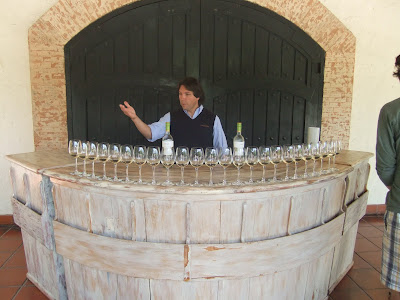
What a weekend this has been. I stayed in Santiago, but didn't really feel like I spent anytime at home, seeing as I went on day trips into the outskirts of Santiago Friday, Saturday and Sunday. Friday (after a Thursday night when we ended up in the same night club as the brother of the incumbent Chilean president!) we started off with an ND program tour to the primary wine growing region around Santiago. Chilean wines primarily come from 7 valleys stretching from several hundred miles north of Santiago to several hundred miles south. We visited 2 wineries, the ever-present Concha y Toro, which is the largest Chilean vineyard and a huge export name, as well as a boutique vineyard William Fevre, which is nearly 100% dedicated to export. Interestingly, this means we sampled from a bottle that was written partly in Portuguese and already had the label certifying which Brazilian company had imported it. I guess we beat them to it! The two setups were decidedly different, ranging from mass industrial production to smaller, more quality conscious production.

We took bikes around this beautiful wine region of Pirque, which despite being less than an hour outside of the hustle of Santiago, has a completely different feel to it. In my further pursuit of wine knowledge, I tasted a couple reds as well as one of the very few whites I have ever liked, a Concha y Toro Sauvignon Blanc Trio wine (made with grapes from three different valleys, hence the "trio" name). It resembled more of a desert than an actual wine, with an incredibly sweet green apple taste. Almost like a jolly rancher! The tour of Concha y Toro also brought us through the famed Casillero del Diablo (Devil's Locker) section, for which a popular line of wine is named. The legend of the name goes that over a hundred years ago one of the principal winemakers had noticed that some of his best bottles of wine were going missing from the cellar. In response, he invented a rumor that this specific section of the cellar was inhabited by the devil. As a result, the robberies stopped! Now there is even a devil silhouette painted on the wall to encourage the rumor (see the above picture). I have since tried the Casillero del Diablo Camenere and can speak for it's quality. Check out my other blog if you're interested in a more in-depth opinion (http://chilewinend.blogspot.com/). On an interesting side note, as this excursion was paid for through my Notre Dame tuition, this marked the first time that my tuition money was used for alcohol. Not that we've been looking for ways to use our dining hall flex points for this use or anything...

Saturday played host to my favorite program excursion so far, a horseback riding tour through the Andes. Part of what made this day trip so much fun was that we weren't riding through any public park, but instead private property. As a result, we saw no more than 5 other people all day, leaving us endless vistas to take in, in solitude. All in all, we rode about 6 or 7 hours, stopping halfway to barbecue some fantastic shish-kebabs next to a waterfall. It was a beautiful day, and I thoroughly enjoyed the ride. We also got the opportunity to see a handful of Andean Condors, absolutely gigantic birds that circle overhead looking for animal carcases to scavenge. I tried to attract one by playing dead on the top of a large hill, but with no success. Menos mal, as they say here in Chile, or a semi-sarcastic "thank goodness". On top of everything else, I had a great time talking to Esteban, our Chilean Politics, Economics, and Culture professor, about all his experience climbing the mountains in the Andes. I really wish I would have gotten more of this in, especially earlier in the semester when I had more time. I feel like I could spend another 6 months here purely climbing mountains, there are just that many peaks and the thrill is that big! I returned back to Santiago to spend the night with my Linares brother Carlos and his girlfriend Kelsey in their Santiago apartment.

The weather didn't cooperate as much today. When I set of early this morning (after a late night of course!), it was clear that it was gonna rain. Perfect for white-water rafting, right? A huge group of 19 of us ventured up in the Cajón del Maipo, a beautiful narrow river valley to the southeast of Santiago to brave the elements on this freezing cold day that was raining and never rose above 50*. Yet the rafting was incredible. They gave us all neoprene wetsuits, neoprene boots, and a thin jacket. It sure didn't keep us toasty, but it kept us warm enough to forget about the cold during the rafting. The rain probably helped the rapids as well, as they very strong, mainly class 3 with a couple class 4 sections. Man was it fun!

All in all, it's been a fantastic weekend, spent mainly in the outdoors. I've gotten to Sunday night here with a total of 13 hours of sleep the past 3 nights, but all was worth it. I am however going to bed now.

jueves, 4 de noviembre de 2010

Spiderman

Atacama Salt Flat, Chile

Atacama Salt Flat, Chile

Machu Picchu, Peru (Let's hope you guessed that one)

BBQ in Mendoza, Argentina

Cerro Pochoco outside Santiago, Chile

Yes, Spiderman. Bare with me for a second. A good friend Amanda Helgerson gave me a Spiderman action figure/pool toy before I headed down to Chile with explicit instructions to take pictures of him everywhere I go. Despite my initial hesitation, I'm sure glad she gave it to me and that I've stuck with it. He goes everywhere with me and most places I actually remember about him, take him out of the bottom of my backpack, and snap a couple cool pictures. The other kids in my program have been following the progress too and have helped out with some awesome picture ideas. All the pictures are available on facebook, in a dedicated album for those of you with access. Otherwise, I've included the highlights here above.

If anyone has ideas for some creative pictures, I'd love to hear them